

Introduction: Why Quantum Computing Matters For decades, classical computers have powered our digital world. But as we push the limits of what these
Introduction: Why Quantum Computing Matters
For decades, classical computers have powered our digital world. But as we push the limits of what these machines can do, a new technology is emerging to take us further: quantum computing. Unlike traditional systems that rely on binary bits, quantum computers use qubits, capable of representing multiple states simultaneously. This allows them to solve problems at speeds classical machines cannot match.
By 2025, the momentum is undeniable. The global quantum computing market is expected to surpass $2 billion by 2025. Investment is also accelerating, with quantum startups raising $500 million in 2024 alone.
Quantum physicist John Preskill summarized the potential perfectly: “Quantum computing will solve problems classical computers can’t.”
What Makes Quantum Computing Different
Quantum computing is not just a faster version of today’s computers. It is a fundamentally new way of processing information. The two principles that make it unique are:
- Superposition: A qubit can exist in multiple states at once, unlike a binary bit that is either 0 or 1.
- Entanglement: Qubits can be linked in ways that allow them to work together, exponentially increasing computing power.
These principles allow quantum systems to perform calculations that would take classical computers centuries to complete.
Why Post-2025 Will Be Transformative

Why Post 2025 Will Be Transformative
The years after 2025 are projected to be a turning point for quantum adoption. As hardware improves and error rates drop, quantum computing will move from research labs to practical applications. Industries such as finance, healthcare, and energy are preparing for breakthroughs that could reshape their futures.
Michelle Simmons, a pioneer in quantum research, captured this sense of possibility: “The possibilities of quantum tech are limited only by our imagination.”
Industries That Quantum Computing Will Transform
Healthcare and Pharmaceuticals
Quantum computers could accelerate drug discovery by simulating molecular interactions at unprecedented levels of detail. This could cut years from the development of treatments for diseases like cancer and Alzheimer’s.
Finance and Investment
Banks and hedge funds will use quantum algorithms for portfolio optimization, fraud detection, and risk management. Simulations that once took days could be completed in seconds.
Cybersecurity
Post-quantum cryptography will become essential. While quantum computers threaten today’s encryption standards, they also enable stronger cryptographic methods to secure communications.
Energy and Climate Science
Quantum simulations could model energy grids, optimize renewable power, and simulate climate systems to design better mitigation strategies.
Artificial Intelligence
Quantum machine learning could give AI systems access to previously unreachable levels of performance, enabling them to analyze massive datasets faster and with more accuracy.
Benefits of Quantum Computing
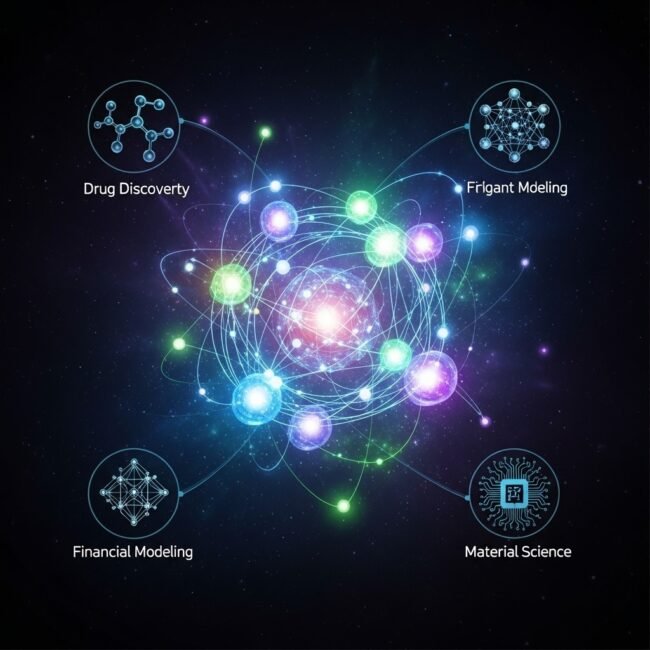
Benefits of Quantum Computing
- Unmatched speed: Ability to process calculations that classical computers cannot feasibly complete.
- Complex problem solving: Ideal for optimization and simulations across industries.
- Scientific breakthroughs: Potential to revolutionize material science, physics, and biology.
- Economic impact: With the market projected beyond $2 billion by 2025, quantum is emerging as a new tech frontier.
Challenges That Remain
Despite its promise, quantum computing still faces significant challenges:
- Hardware limitations: Building stable qubits with low error rates is complex.
- Cost barriers: Quantum machines are expensive and require specialized environments.
- Skill shortages: There is a global shortage of scientists and engineers trained in quantum computing.
- Security risks: Once mature, quantum systems could break current encryption, forcing urgent adoption of post-quantum security.
The Role of Governments and Businesses
Governments are investing heavily in quantum initiatives. The U.S., China, and the EU are leading the race with multi-billion-dollar research funds. Private companies like IBM, Google, and Microsoft are also building cloud-based quantum platforms, making the technology more accessible.
The $500 million investment in quantum startups in 2024 reflects how venture capital is accelerating the ecosystem. Startups are tackling problems from quantum software to hardware stability, fueling innovation beyond research institutions.
The Future Beyond 2025

The Future Beyond 2025
Looking forward, quantum computing is set to revolutionize how we approach the world’s biggest challenges.
- Mainstream adoption: By the late 2020s, cloud-based quantum platforms could be widely accessible.
- Integration with AI: Combining AI with quantum could unlock advanced machine learning applications.
- New industries: Entire sectors may emerge around quantum-enhanced cybersecurity, finance, and biotechnology.
- Global competition: Nations will race to secure leadership in quantum, similar to the space race of the 20th century.
Conclusion: A Revolution Just Beginning
Quantum computing is still in its early days, but its potential impact post-2025 is massive. With the global market surpassing $2 billion by 2025 and $500 million flowing into startups in 2024, both governments and private investors see its transformative potential.
John Preskill’s insight that “Quantum computing will solve problems classical computers can’t” reminds us why this technology matters. And Michelle Simmons’ belief that “The possibilities of quantum tech are limited only by our imagination” inspires us to consider its boundless future.
As we move past 2025, quantum computing is set to become one of the most disruptive forces in technology, reshaping industries, economies, and the very boundaries of what is computationally possible.

COMMENTS